
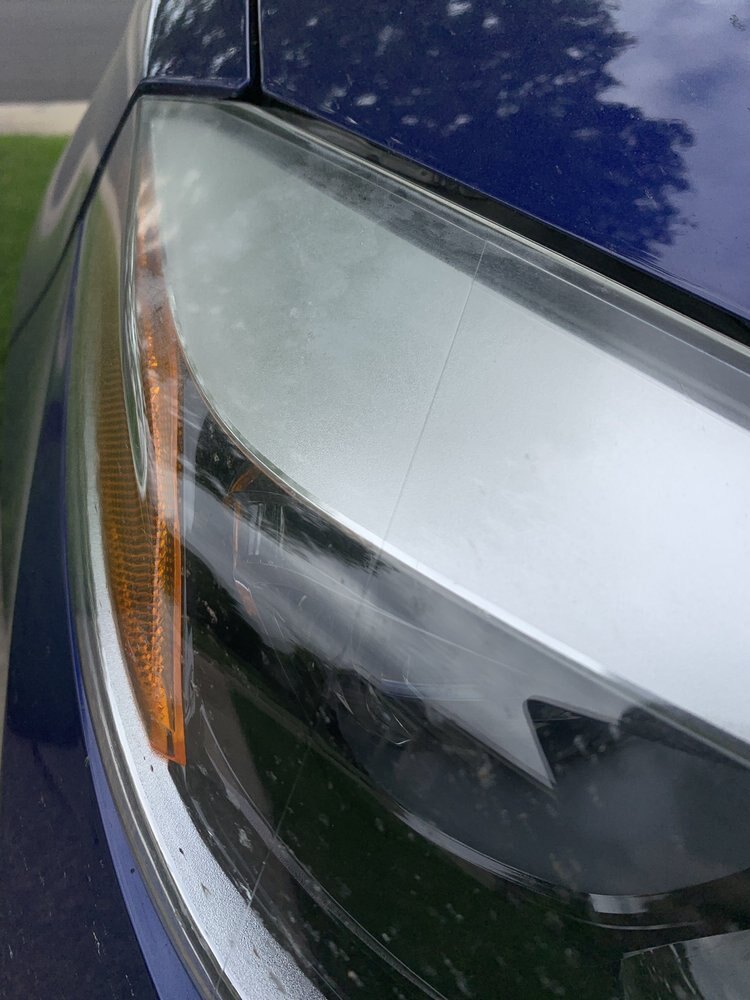
You drove through Valley fog and realized your headlights looked dim while the windshield caught every passing glare. Now you are deciding whether cleaning the glass is enough or the cloudy lenses need restoration before the next foggy drive.
Clean both sides of the glass first. If the lens itself is yellow or rough on the outside, restoration may help; trapped moisture or cracked housings call for a different inspection.
How fog changes what you can see
Fog is a cloud of tiny water droplets sitting on the ground. Every droplet reflects and scatters light. When your headlights shine into it, much of the light bounces back toward you instead of reaching the road.
That is why high beams make dense fog look worse. More light going out means more light reflecting back. It is also why anything else that scatters light, like a cloudy lens or a smeared windshield, compounds the problem.
On the open stretches around Modesto, especially on Highway 99, Highway 132 and the county roads between towns, fog can go from thin to dense in a very short distance. You need every bit of useful light and every bit of clear view.
What a yellowed lens does in fog
Modern headlight lenses are plastic. Over years of Valley sun, the protective layer on the outside breaks down and the plastic oxidizes. It turns yellow, hazy and rough.
A hazy lens does two things at once. It blocks some of the light from getting out, and it scatters what does get out in every direction. In fog, that scattered light lights up the droplets right in front of the car, which is the glare you are trying to avoid.
The result is a car that is harder to see from outside and a driver who can see less from inside, in exactly the conditions where both matter most.
The windshield film nobody notices
Most drivers clean the outside of the windshield and never think about the inside. The inside collects a greasy haze from plastics off-gassing in the sun, from the defroster, and from hands touching the glass.
In daylight you barely see it. At night, in fog, with oncoming headlights, that haze lights up and makes the whole windshield glow. It also grabs moisture, so the glass fogs faster and clears slower.
Clean both sides of the glass properly before fog season, including the lower edge of the windshield by the dash, which is hard to reach and usually the dirtiest part.
If the haze is on the outside of the lens, request a Headlight Restoration assessment or call (209) 526-8688. Ask the shop to check whether restoration fits your lights before you book.
Explore Headlight Restoration for Modesto drivers.
Taillights and being seen
Visibility is not only about seeing. In fog, the driver behind you needs to find your car before they are on top of it. Hazy or dirty taillights make that harder.
Check that all rear lights work and that the lenses are clean. Remember that on many cars, daytime running lights do not turn on the taillights. In fog, switch to your low-beam headlights so the rear lights come on too.
Is restoration worth it, and how long will the car be away?
Restoration is worth considering when the cloudiness is on the outside of the lens; cleaning the windshield alone cannot clear that. A cracked housing or internal moisture needs another solution. Ask for an assessment, what protection follows polishing, and an appointment and pickup window for your particular vehicle instead of relying on an assumed turnaround.
When restoration helps and when it does not
Most yellowed, hazy lenses are oxidized on the outside surface. Restoration removes that damaged outer layer, refines the plastic back to clear, and protects it so it does not immediately start clouding again.
Restoration cannot fix damage inside the housing. If there is moisture trapped behind the lens, the reflector inside is flaking or burnt, or the plastic is cracked, the housing itself needs attention. A quick look at the lens in good light usually tells you which situation you are in.
A short fog-season checklist
Look at your headlight lenses in daylight. If they are yellow, hazy or rough to the touch, that is the moment to deal with them, not after the fog is already here.
Clean every piece of glass inside and out, including mirrors. Check the wiper blades for cracks or hardening and fill the washer fluid.
Walk around the car with the lights on and confirm every bulb works: low beams, high beams, taillights, brake lights and signals.
Make sure your defroster moves plenty of air. If it seems weak, the cabin air filter may be clogged with a summer of dust.
Driving it safely
Slow down far more than feels necessary, leave a large gap to the car ahead, and use low beams. Use the right edge line as your guide rather than following the taillights in front of you.
If the fog becomes too dense to continue, get completely off the road into a parking lot rather than stopping on the shoulder.
Ready to talk about your car?
Do not guess from a cloudy photo: book a lens check with CAR PRETTY or call (209) 526-8688 and describe what you see.
Read about Headlight Restoration and visiting from Modesto.