
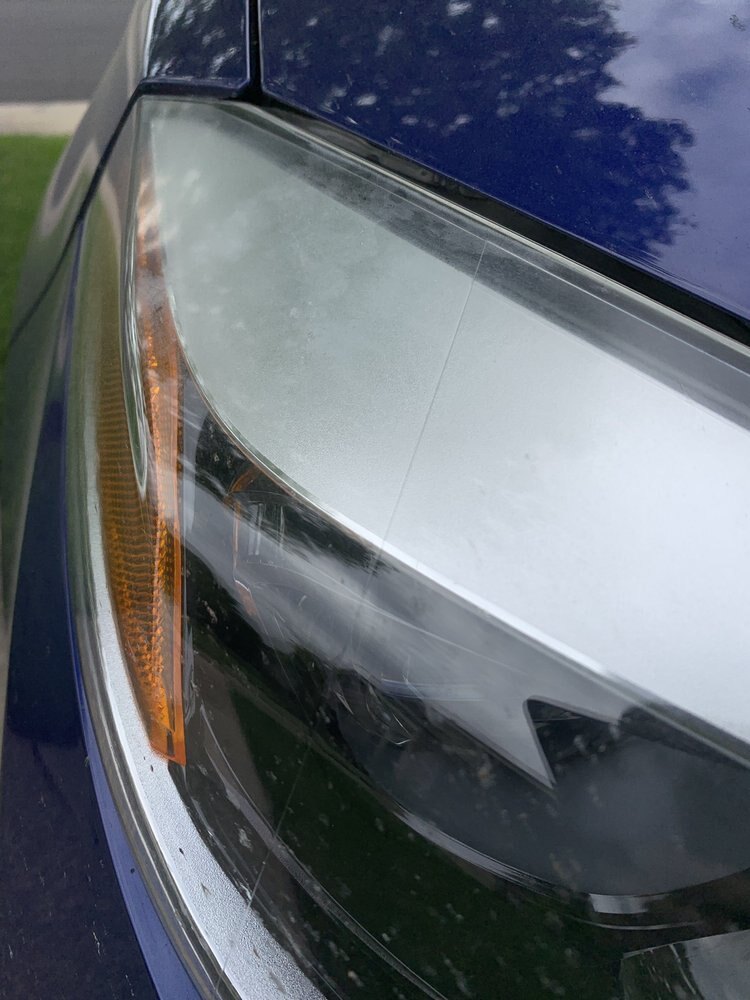
Most cloudy headlights can be restored, because the haze you are looking at is damage to the outer surface of the plastic lens rather than damage inside the light. When the problem is on the outside, it can be cut back and refinished.
The exception is when the failure is inside the housing: moisture sitting in the lamp, a cracked lens, a broken mounting tab, or a reflector that has burned or peeled. Those are replacement conversations, and no amount of polishing fixes them. Here is how to tell the difference before you spend money on the wrong answer.
Why headlights go cloudy in the first place
Modern headlight lenses are polycarbonate, not glass. Polycarbonate is tough and light, which is why it replaced glass, but it does not like ultraviolet light. From the factory it comes with a hard UV coating on the outside to protect it.
That coating is what fails. Sun breaks it down over time, and it starts to lift, craze, and go yellow or milky. Once the coating is compromised, the plastic underneath oxidizes too, and the surface goes from clear to hazy to chalky.
In the Central Valley this happens faster than it does in cooler, cloudier places. Long hot summers, intense direct sun, and cars that park outside all day add up. Add windshield-height road grit from valley highways and the surface gets sandblasted on top of everything else.
What restoration actually involves
Restoration is not a wipe-on product. Done properly it is a refinishing process, which is why the results last differently than a bottle from the parts store.
The failed coating and the oxidized layer of plastic are sanded off in stages, working from a coarser abrasive to progressively finer ones until the surface is uniform. Then the lens is machine polished back to optical clarity. Then, critically, a new protective layer is applied, because bare polycarbonate with no UV protection will start hazing again in the sun.
That last step is the one most quick fixes skip. If you have ever restored a headlight yourself and watched it go yellow again, that is almost always why.
Signs your lenses are a good candidate
Restoration is usually the right call when the haze is even across the lens, when it feels rough or chalky to the touch, and when the inside of the lens still looks clean when you shine a light at it.
Yellowing that fades if you wet the lens with water is another good sign. If water briefly makes it clearer, you are looking at surface texture, and surface texture can be removed.
Light scratching, bug etching, and sand pitting are also generally correctable, because all of those live on the outer face of the plastic.
Signs the housing needs to be replaced
Look for moisture. If there is condensation inside the lens, water is getting in through a failed seal or a crack, and cleaning the outside does nothing about it. Standing water will eventually take out the bulb socket and corrode the connector.
Look for cracks. A crack in the lens, even a small one, will keep letting water in and can spread once the plastic is worked on.
Look inside at the reflector. If the silver surface behind the bulb is discolored, bubbled, peeling, or burned in one spot, the light output is already compromised and clearing the lens will not bring the beam back.
Finally, check the mounting tabs. These are thin plastic and they break in minor front-end impacts. A headlight that will not hold its aim is a safety problem regardless of how clear it looks.
The borderline cases
Some lenses fall in between. Deep crazing, where the surface has a fine spiderweb pattern that runs into the plastic rather than sitting on it, may improve a great deal without going fully clear.
Internal film is another gray area. If the haze is on the inside face of the lens from years of heat cycling, outside work will only get you part of the way. Holding a flashlight against the lens at night and looking at where the fog sits tells you a lot.
The honest thing a shop can do with a borderline lens is tell you in advance that it will improve but may not look new, and let you decide from there.
Why it matters beyond looks
Cloudy lenses are not just cosmetic. A hazy surface scatters the light instead of projecting it, so the beam loses its shape and your usable light down the road shrinks. The bulb is doing the same work, but less of it reaches where you need it.
That is a real issue on valley roads. Unlit two-lane stretches, farm equipment turning off the road, irrigation ditches with no shoulder, and pedestrians and cyclists in dark clothing are all things you want to see early rather than late.
Fog season makes it worse. Scattered light bounces back at you off the water in the air, so hazy lenses do not just dim the road, they add glare in exactly the conditions where you need contrast.
Keeping them clear once they are fixed
Once the lenses are restored and protected, the enemy is the same as before: sun. Parking in shade or a garage when you can is the single most effective thing you can do.
Wash the lenses when you wash the car rather than letting bug residue bake on them, and avoid scrubbing them with anything abrasive, including a dry towel on a dusty lens.
Keep an eye on them each spring. Catching the first signs of the protective layer failing is much easier than dealing with a fully chalked lens two summers later.
Getting an answer on your car
The quickest way to know whether you are looking at a restoration or a replacement is to have someone look at the lens in daylight and with a light behind it. It takes a couple of minutes and it saves you from buying the wrong solution.
Car Pretty is at 4207 McHenry Ave in Modesto and is open from Monday–Friday, 7:00 AM to 4:00 PM. Call (209) 526-8688 or stop in and ask for an honest look at the lenses.
If the housing does need to be replaced, it helps that the detailing department and the auto repair and smog department are on the same lot, so the conversation about the lens and the conversation about the car do not have to happen in two different places.